
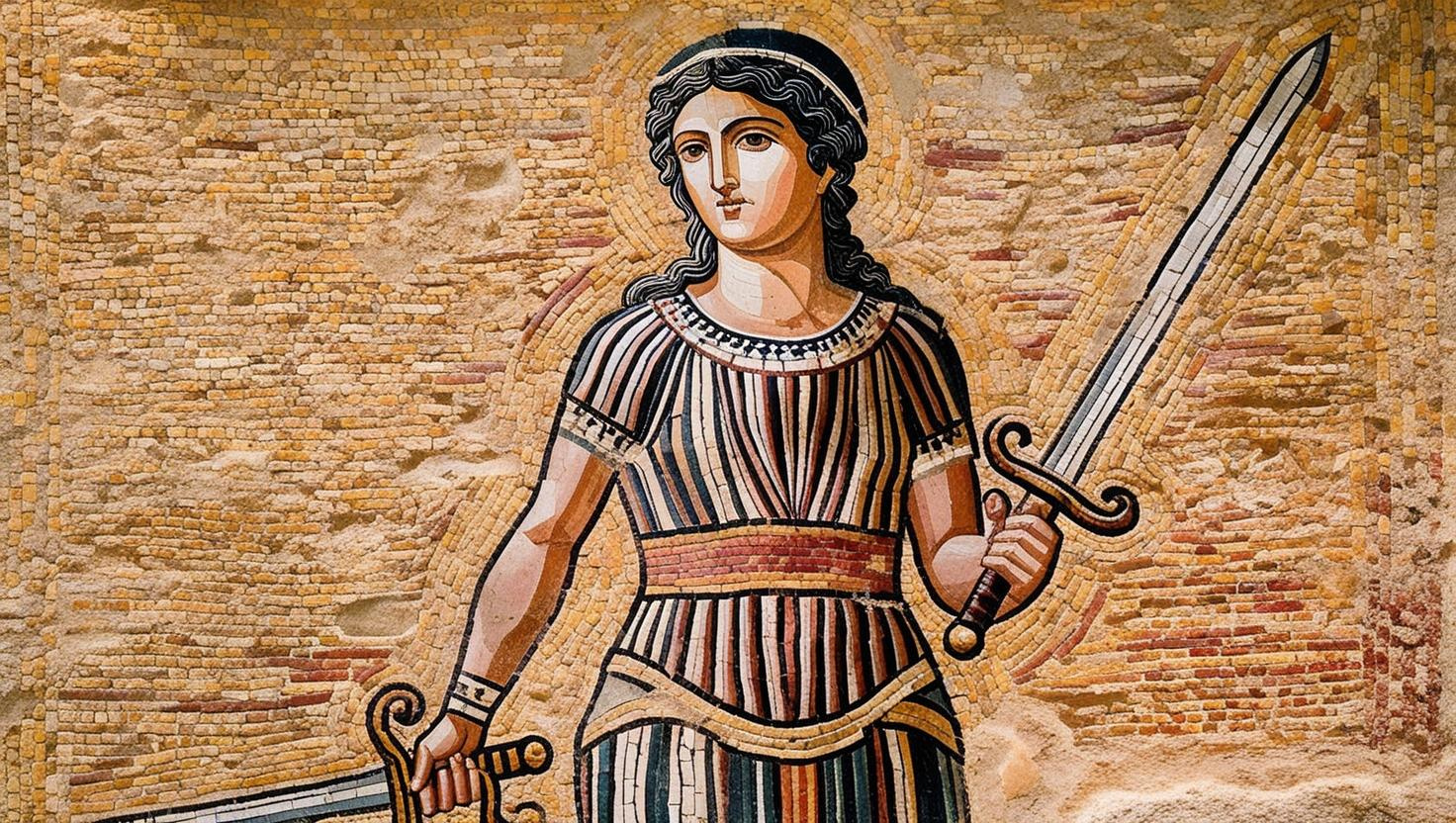
What is the Book of Judith?
Most scholars date the Book of Judith to the beginning of the first century BCE, following Judea’s victory over its Hellenistic rulers, the Seleucids. The narrative is filled with deliberate anachronisms and impossibilities so obvious that ancient readers would have instantly recognized it as a pointed critique of their own political realities. By jumbling geography and merging different historical periods, the author signaled that this was satire. At one point, the story takes place somewhere in the Far East; next, in Asia Minor or North Africa; references to Persian, Babylonian, Greek, and Assyrian cultures are mixed without regard for chronology. The exaggeration acted as a cover, allowing a pointed criticism of their former oppressors to pass unnoticed. Early audiences likely found the parody hilarious, the ancient equivalent of claiming that Napoleon is President of the United States and keeps an office on the moon.
The art of Judith
Judith has been depicted in every creative setting imaginable: Martha Graham's modern dance performances, medieval poetry and paintings, stained glass panels in the Sainte-Chapelle in Paris, operas, and sculptures by Renaissance masters. Michelangelo painted her on the ceiling of the Sistine Chapel, and the contemporary artist Judy Chicago included Judith in a place setting in her famous 1979 installation, The Dinner Party. There have been many symphonies and plays—and the list of art created in her honor is endless.
Are there novels written about Judith?
No one has written a historical novel about her until now, and I think I understand the reason. The “chaos” of the narrative doesn’t hinder most artistic adaptations, yet in writing a novel, the very elements that were obvious “inside jokes” to ancient audiences become utterly perplexing to modern readers. I sensed a universal story beneath the satire, one that deserved to be told in a way that reveals the characters’ motivations through language and emotional nuance familiar to contemporary readers. With such a compelling plot and a fearless central heroine, it would be a loss to let Judith fade into literary obscurity. So the question becomes: how can the Book of Judith be made clear and resonant for today’s audience?
I began by sorting every historical reference into its proper era and then charted a path through the geographical maze that required the fewest departures from the original text. That process ultimately pointed to the reign of Sennacherib, King of Assyria (705–681 B.C.E.), as the most coherent setting for my novel.
Judith The Wise adds to the ongoing conversation about how women can use wisdom to change the world.
For more information
Brenner, Athalya, ed. - A Feminist Companion to Esther, Judith & Susanna. Feminist Companion to the Bible 7. (Sheffield, Eng.: Sheffield Academic Press, 1995)
Brine, Kevin R., Elena Ciletti, Henrike Lahnemann, eds. - The Sword of Judith: Judith Studies Across the Disciplines (Cambridge: Open Book Publishers, 2010)
Craven, Toni - Artistry and Faith in the Book of Judith. 70 Society of Biblical Literature (Michigan: Scholars Press, 1983)
Enslin, Morton Scott - The Book of Judith: Greek Text with an English Translation. (Leiden: Brill, 1973)
Exum, J. Cheryl, ed. - Reasoning with the Foxes: Female Wit in a World of Male Power. Semeia 42. Society of Biblical Literature (Atlanta, GA: Scholars Press, 1988)
LaCocque, Andre - The Feminine Unconventional: Four Subversive Figures in Israel's Tradition. Overtures to Biblical Theology. (Minneapolis: Fortress, 1990)
Moore, Carey A. – Judith (Garden City, N.Y.: Doubleday Collection, 1985)
Nowell, Irene - Jonah, Tobit, Judith. Volume 25. New Collegeville Bible Commentary: Old Testament. (Liturgical Press, 2015)
Otzen, Benedikt - Tobit and Judith. Guides to the Apocrypha and Pseudepigrapha (London: Sheffield Academic, 2002)
Streete, Gail Corrington - The Strange Woman: Power and Sex in the Bible (Louisville: Westminster John Knox, 1997)
VanderKam, James C. - No One Spoke Ill of Her: Essays on Judith. Early Judaism and Its Literature 2. (Atlanta: Scholars Press, 1992)
Wills, Lawrence M. - The Jewish Novel in the Ancient World (Ithaca: Cornell University Press, 1995)