
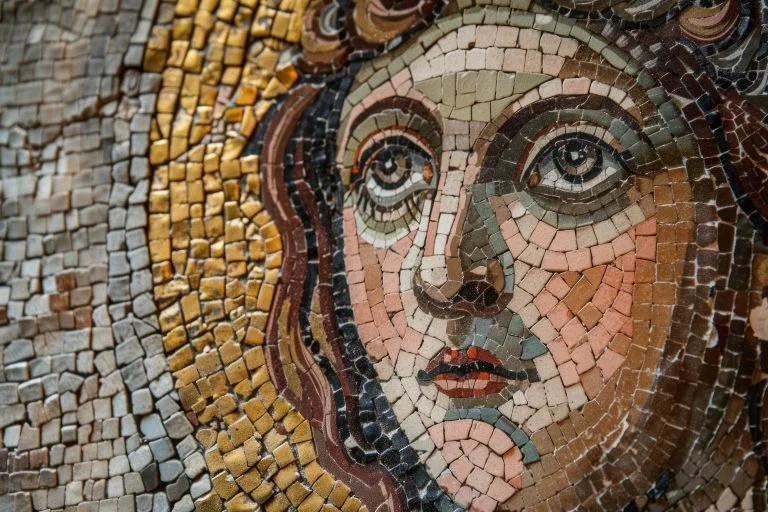
“Greet Andronicus and Junia, my fellow Jews who have been in prison with me. They are outstanding among the apostles, and they were in Christ before I was.” Romans 16:7(NIV)
Who was Junia?
Like other members of the early Jesus movement, Junia and Paul were Jewish and followed the ancient traditions of the people of Israel. The term “Christians” was not used until several decades after Jesus’ death.
When Paul wrote that Junia was “in Christ before I was,” he meant Junia believed Jesus was the Messiah before Paul reached the same conclusion on the road to Damascus. His vision of Jesus occurred around 34 C.E., a few years after Jesus’ death. Therefore, it is very likely that Junia was part of the group of disciples in Jerusalem waiting for the Messiah’s return. She may have even traveled with Jesus earlier in his mission. We don’t know when Junia received the title of “apostle,” nor when or where she was imprisoned alongside Paul.
It’s a common belief that Peter founded the church in Rome, but the New Testament does not mention him ever traveling there. The context of Paul’s letter to the Romans, written in 57 or 58 CE, suggests that Junia was not only present in Rome before him but also held a prominent position within the early Christian community.
Was Junia a historical person?
Most biblical scholars today consider Junia a genuine historical figure, not a fictional character. As researchers note, Paul’s authentic letters are filled with detailed historical references, including coworkers, travel plans, and greetings from well-known regions, making them among the earliest and most historically grounded Christian writings.
The letter to the Romans was written only about 25 years after Jesus’ death, when eyewitnesses and first-generation followers were still alive. Therefore, the inclusion of Junia in Paul’s list of greetings in Romans strongly suggests she was a contemporary known personally to Paul, not an allegorical or symbolic figure.
Are Junia and Joanna the same person?
Many Jews in the Roman world adopted Latin names similar to their Hebrew or Greek names. Some scholars contend that the biblical character Joanna, mentioned in Luke 8:2, likely chose a Latin name as a member of Herod Antipas’ court. She probably used both names in different situations. In my historical novel, Junia: The Forgotten Apostle, I follow the suggestion that Junia and Joanna are the same person.
Who was Joanna?
““The twelve were with him, as well as some women who had been cured of evil spirits and infirmities: Mary, called Magdalene…and Joanna, the wife of Herod’s steward Chuza, and Susanna, and many others, who provided for them out of their resources.” Luke 8:2
From this passage we learn several things about Joanna. She was:
possessed by a demon or illness and cured (by Jesus)
married to Herod Antipas’ manager of his royal estate
wealthy enough to help finance Jesus’ mission
Chuza’s position as the high-ranking household and financial administrator placed Joanna within the inner circles of wealth and political power, giving her access to information and influence unusual for most women of her time.
In Luke chapter 10, we learn that Joanna was among the women who visited Jesus’ tomb and learned that Jesus had been resurrected. Along with the other women, she rushed to the other disciples to tell them what she’d seen.
Luke 23:49 mentions that the woman who followed Jesus from Galilee observed his crucifixion. Since Joanna is earlier identified as one of the Galilean women who accompanied and supported Jesus, it is highly plausible that she belonged to this same group of witnesses.
Was Joanna a historical person? Most mainstream biblical scholars consider Joanna a plausible historical person, though the degree of certainty differs from that for figures in Paul’s letters such as Junia. Joanna is mentioned twice in the Gospel of Luke, both times within material scholars regard as built on early oral traditions about Jesus’ female followers. While Luke’s gospel was written several decades after Jesus’ death (ca. 80–90 CE), most critical commentators agree that Joanna’s name preserves a memory of an actual follower known in early Christian circles.
Given all this information, Junia: The Forgotten Apostle traces her life story, from her marriage to a royal courtier, her demonic possession and healing, her missionary work with Jesus, and her witness to his death and resurrection. With the title “apostle,” she spreads Jesus’ teachings, travels with Paul, spends time in prison with him, and becomes a leader in the Roman Christian community. Along the way, she faces persecution both from the outside world and within her own community of believers.
For more information
To prepare for writing about Junia, I read extensively about the biblical figure. A quick online search for “Junia, the apostle” will yield a lot of accurate and well-researched material, along with discussions that use misleading scholarship to argue that Junia wasn’t a woman or that she wasn’t an apostle.
Sign up for my newsletter and receive “The Top 4 Reasons Junia was an Apostle.”
Here's a select bibliography if you're interested in exploring the topic of Junia further.
Bauckham, Richard – Gospel Women: Studies of the Named Women in the Gospels (Grand Rapids: William B. Eerdmans Publishing Co., 2002)
Brooten, Bernadette J. – “Junia… Outstanding among the Apostles’ (Romans 16:7).” in Women Priests: A Catholic Commentary on the Vatican Declaration, ed. L.S. and A. Swindler. (New York: Paulist, 1977) 141-44.
Brooten, Bernadette J. – “Junia” in Women in Scripture: A Dictionary of Named and Unnamed Women in the Hebrew Bible, Meyers, Carol, Toni Craven and Ross S. Kraemer, eds. (Grand Rapids, MI: Eerdmans, 2000)
Epp, Eldon Jay – Junia: The First Woman Apostle (Minneapolis: Fortress Press, 2005)
Fiorenza, E. Shussler – “Missionaries, Apostles, Cowokers: Romans 16 and the Reconstruction of Women’s Early Christian History,” Word and World [St. Paul, Minn.] 6, 4 (1986): 420-33.
Pederson, Rena – The Lost Apostle: Searching for the Truth About Junia (Jossey-Bass, 2006)
Thorley, John – “Junia, a Woman Apostle.” Novum Testamentum 38 (1996): 18–29.
Witherington III, Ben – “Joanna: Apostle of the Lord—or Jailbait?” Bible Review, Spring 2005
Witherington III, Ben – “On the Road with Mary Magdalene, Joanna, Susanna, and Other Disciples– Luke 8:1-3,” in A Feminist Companion to Luke. Feminist Companion to the New Testament and Early Christian Writings 3. Amy-Jill Levine and Marianne Blickenstaff, eds. (London: Sheffield Academic Press, 2002).